
At every stage of the journey towards helping a person leave the street for good, their mental health is at the heart of our approach. Whether it involves building a relationship of trust during the first contacts or ensuring that they can once again live independently in society once they are housed, assessing and supporting their psychological health are major challenges for our organisation.
In recent years, considerable efforts have therefore focused on finding concrete responses to this reality. These years of reflection, experimentation and work on the ground have led, among other things, to the development of ReDiCo, which our psychological team is proud to present.
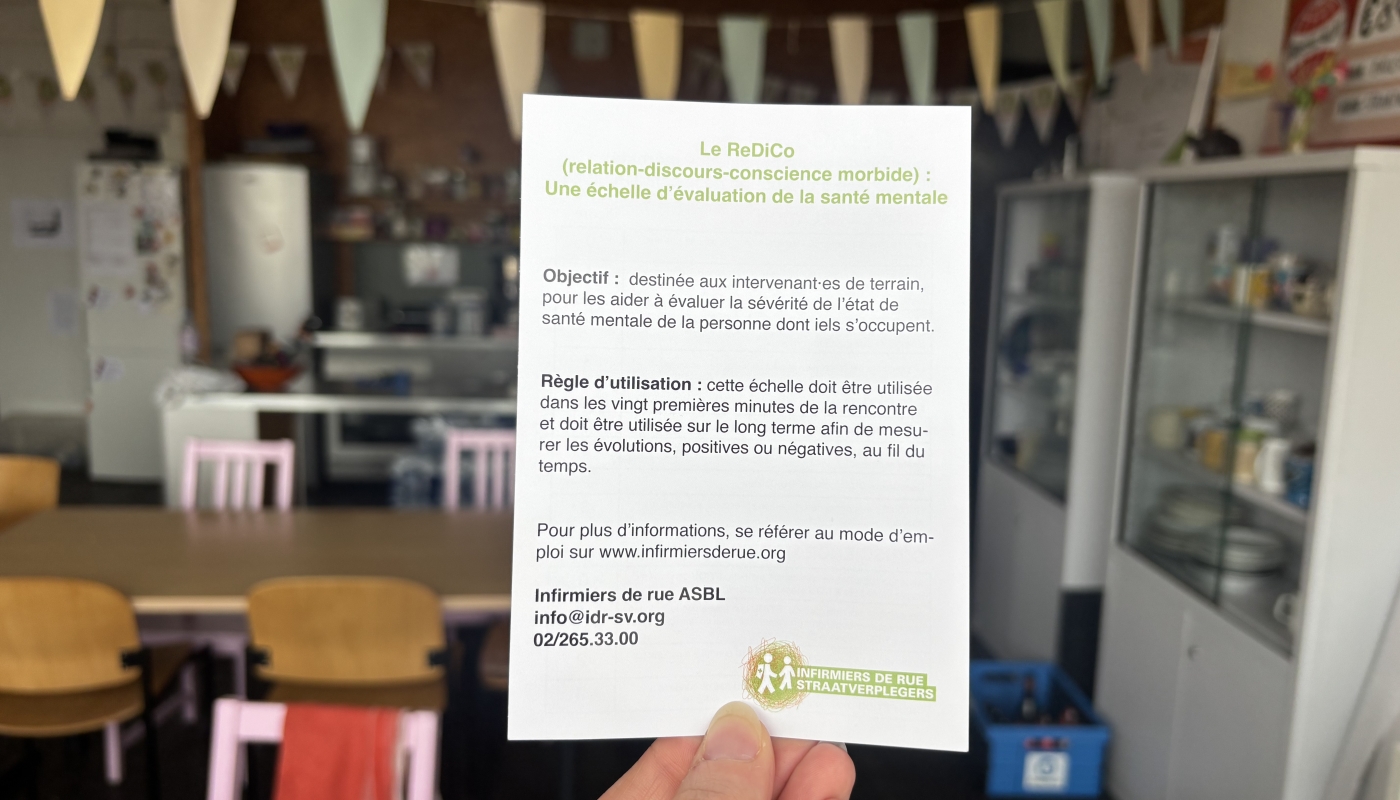
ReDiCo, the new mental health assessment tool
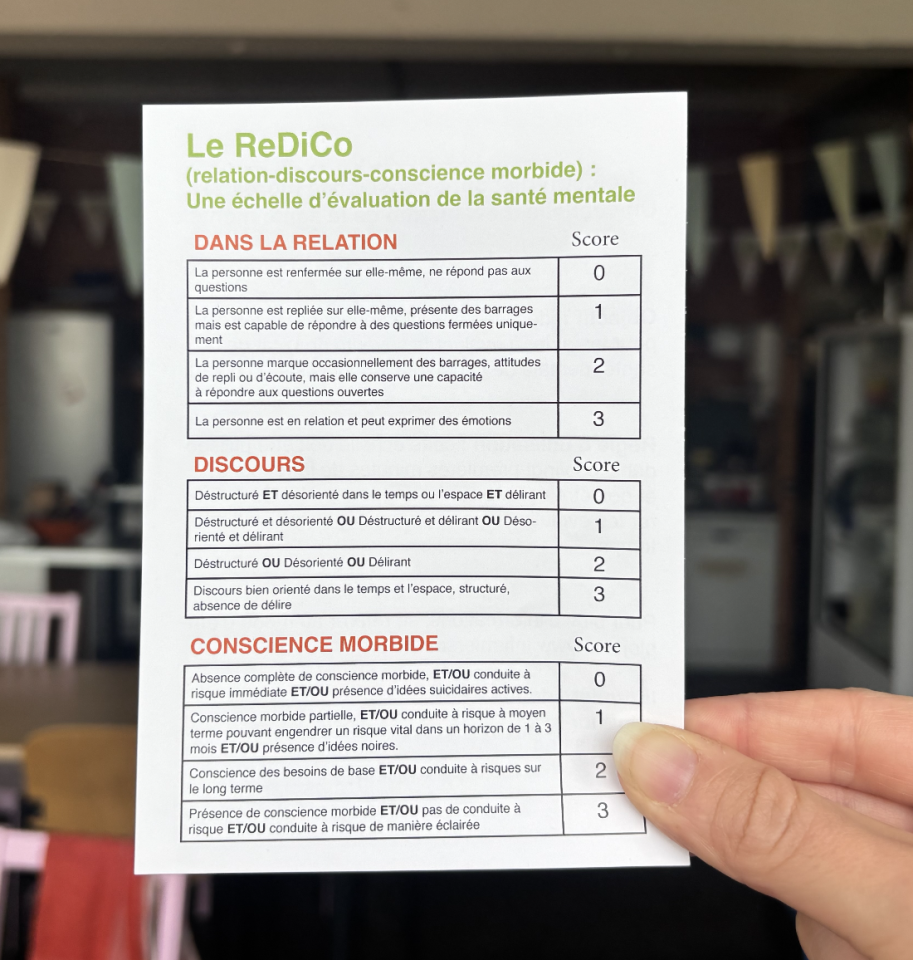
ReDiCo – for Relationship, Discourse, Illness Awareness (FR : Relation, Discours, Conscience morbide) – is an assessment scale designed to help professionals working on the ground objectively and consistently assess the mental health of the people they support, in order to assist decision-making in the field and structure the steps that follow.
For each of the three criteria mentioned above, different levels of severity – ranging from 0 to 3 – have been defined. Assessing a person therefore results in an overall score between 0 and 9, for which a more or less clear course of action is defined. A score below 3, for example, means that calling the emergency services should be considered.
Carefully considered criteria
As mentioned above, the assessment of mental health is based on three dimensions: Relationship, meaning the person’s ability to establish relationships and interact with others; Discourse, which concerns the coherence and intelligibility of what they say; and Illness Awareness, which refers to the degree to which the person is aware of their own mental state.
These three criteria were obviously not chosen at random. They are based on those defined by Belgian legislation on the protection of people with mental illness, which sets out the conditions under which a protective measure may be considered. This makes it possible to place the teams’ actions within a legal framework in cases where the person’s situation requires further intervention in their care.
When should ReDiCo be used?
The ReDiCo assessment should be carried out within the first 20 minutes of meeting the person, in order to assess their ability to maintain their psychological defences and contain any potential delusional elements during this period. However, ReDiCo is particularly meaningful when used over time. By repeating the assessment over the course of several encounters, teams can monitor how the situation evolves: observing an improvement, stabilisation or, on the contrary, a deterioration in the person’s condition.
ReDiCo is therefore an observation tool, a decision-making aid and a monitoring tool. Thanks to this tool, professionals have a common language that enables them to assess each situation more accurately, based on concrete elements rather than each individual’s own impressions.