
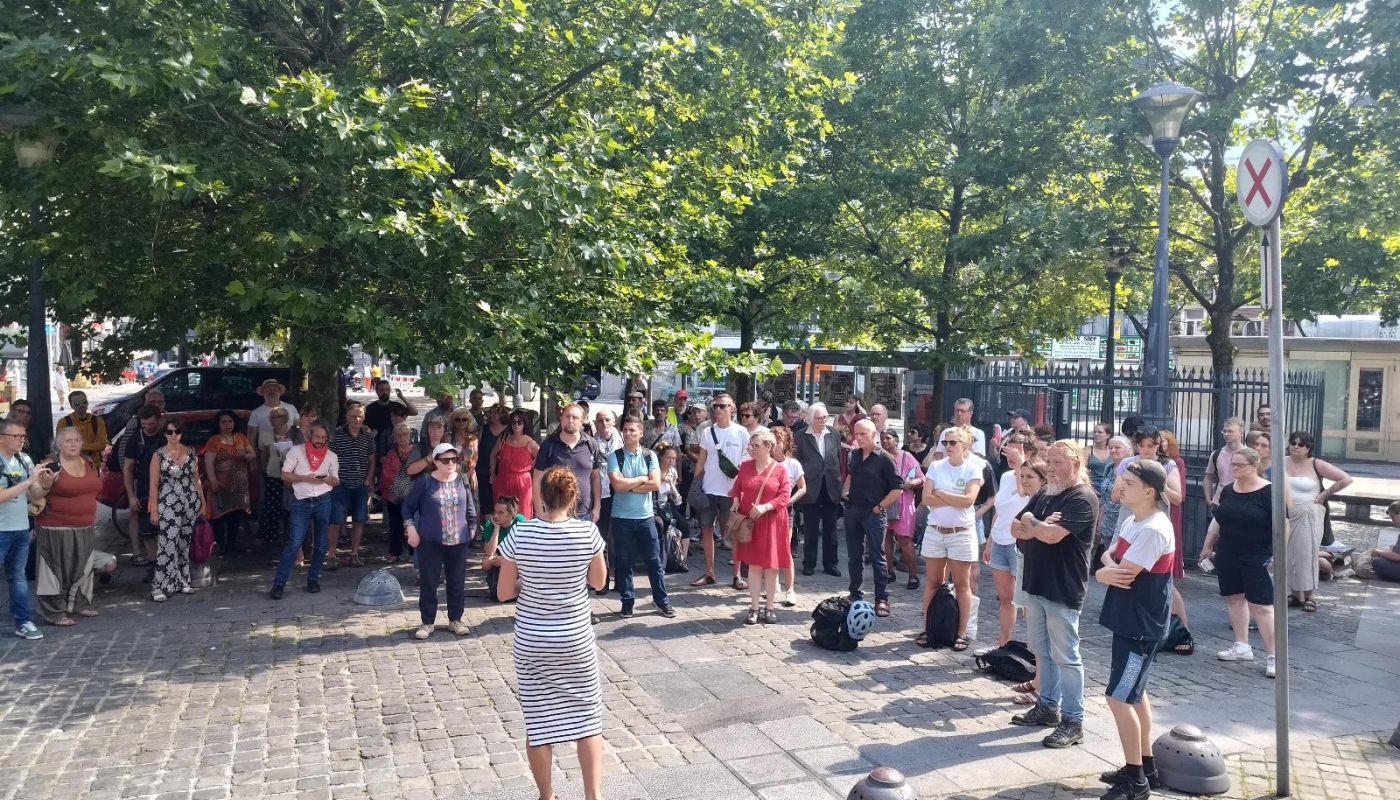
This summer, homelessness and severe poverty have received significant attention in the news in Liège. Residents and shopkeepers have expressed their concerns, distress or frustration about drug use in public spaces, the risk of fires breaking out in certain green areas, and feelings of insecurity.
We hear these concerns. They are part of the reality in our city, and there is no point in denying them. But we, professionals working in the homelessness, health and social sectors, want to reiterate one essential point: people experiencing homelessness did not suddenly appear in public spaces this summer. The latest count identified 2,160 people without a home, including nearly 260 people living on the street. Moving them will not make homelessness disappear.
A reality that does not disappear by moving it elsewhere
This situation is the result of problems that have been known for a long time. When responses in terms of housing, health, harm reduction and social support are insufficient, poverty does not disappear. It eventually worsens, becomes more visible and becomes concentrated in public spaces.
We therefore cannot reduce what is happening today to a question of public order or to the presence of people experiencing homelessness in certain neighbourhoods or green spaces. The current situation is also the consequence of political choices at different levels of government: the severe shortage of affordable housing, insufficient resources devoted to support, overstretched services, difficulties in accessing healthcare, and the closure of the safer drug consumption facility all contribute, to varying degrees, to this reality.
Added to this are interventions and checks at Liège-Guillemins station, the displacement of people and the loss of subsidies for certain organisations working on the ground. When people move or are forced to leave a place, they do not stop being homeless, using drugs or needing healthcare. They have to find somewhere else to go.
This is what leads to situations such as those at the Coteaux de la Citadelle or to drug use in the city centre. But this is not the problem itself; it is the visible symptom of a broader problem. Nor is it limited to one place: it moves from one neighbourhood to another as checks and evictions take place.
A frontline sector that is also under pressure
Meanwhile, the sector itself is also under pressure. Health and social care professionals have to reach out to people who are furthest removed from services, maintain a presence on the streets, manage increasingly complex situations, support people with administrative procedures, work with neighbourhoods and develop solutions to help people leave the streets. These are essential tasks, but they are still too often carried out with largely insufficient human and financial resources, which continue to decrease in relation to the scale of the needs and the sharp rise in poverty.
As professionals in the sector, we are witnessing this deterioration of the situation and are concerned that we no longer have the necessary resources to meet these needs.
Safety and solidarity are not incompatible
We must not pit citizens against people experiencing severe poverty. It is important for everyone to feel safe in their neighbourhood and in public spaces. These objectives are compatible with a policy based on solidarity. A policy that also enables harm reduction. Current security-based responses temporarily displace problematic situations. They do not address the root of the problem. To do so, we must not simply manage the visible consequences of homelessness, but finally provide the necessary resources to tackle its causes and implement the solutions that are already known.
We therefore call on public authorities to make concrete choices: support sustainable rehousing solutions and increase the supply of public housing, reopen the safer drug consumption facility, strengthen funding for organisations providing street outreach and support, and develop responses in the areas of health and mental health. The situation will be addressed by choosing housing, health, harm reduction and support.
Signatories:
- Street Nurses
- Action Vivre Ensemble
- SSADA
- L'ASBL Benoit et Michel
- SSM Centre Alfa
- Occupons le terrain
- Resto du coeur Liège
- ATD Quart Monde Belgique
- Les Sentinelles de la Nuit