
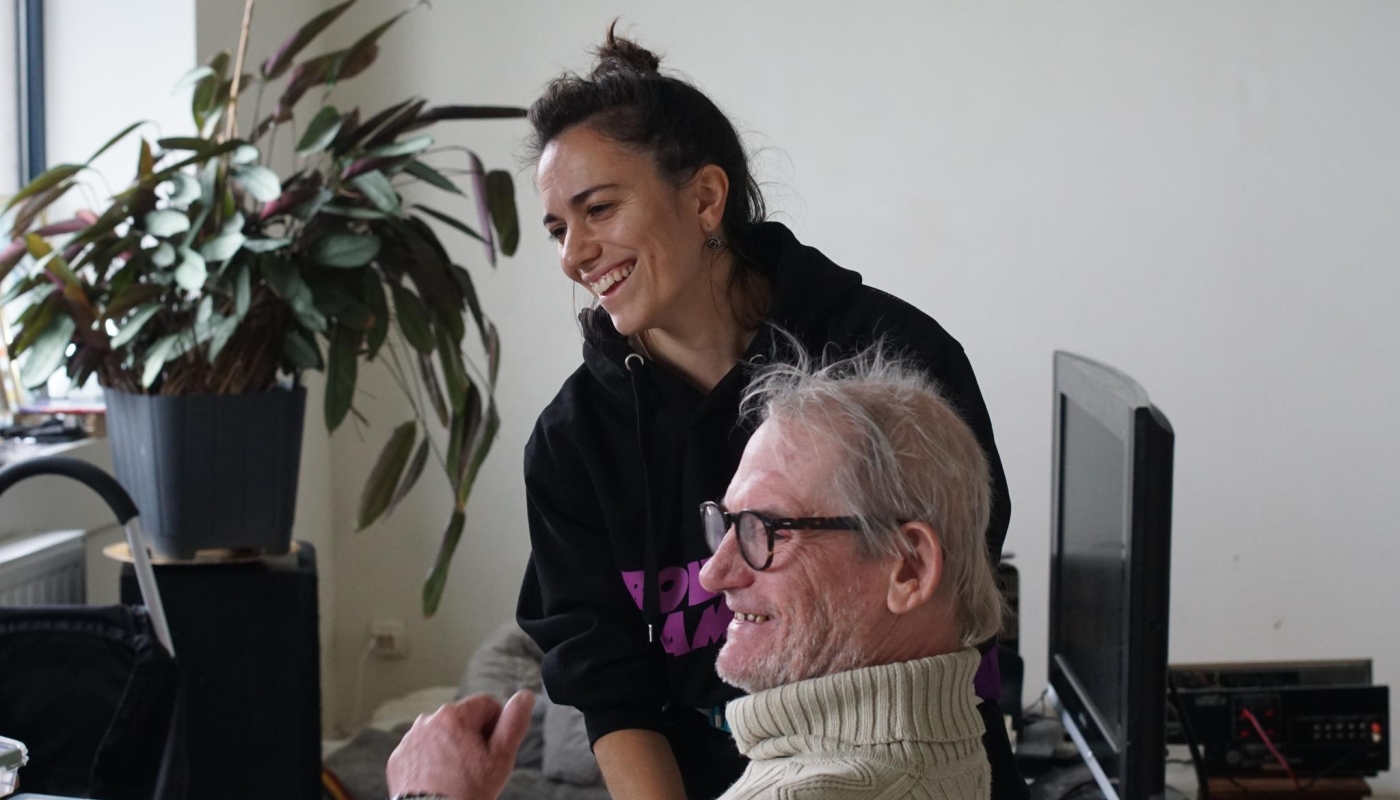
Gaining access to housing after a long period of homelessness is both a long-awaited and deeply destabilising step. As our colleague Dr Pierre, who passed away in March 2025, often reminded us: moving is one of the most stressful events in a person’s life.
Moving after life on the streets: settling in, making a home your own, and reducing anxiety
Within our Housing First programmes, we see how moving into housing can trigger anxiety. That is why we do everything possible to help people feel at home and take ownership of their new living space.
Thanks to the furnishing service (SIL), people can choose their furniture, decorations and essential items, allowing them to settle in under the best possible conditions. However, over time, we have realised that well-being in housing does not depend solely on material conditions. One key factor is having access to a strong local support network.
Among the most important actors in this network are home care workers and domestic helpers, whose role is often underestimated.
Home care workers, domestic helpers and public social services: a local network for autonomy, social connection and dignity
We work closely with Public Social Welfare Centres (CPAS/OCMW) and private organisations. Their support is diverse and invaluable: maintaining the home, assisting with shopping, helping with meal preparation and supporting administrative procedures.
But their role goes far beyond practical tasks. Through their regular and reassuring presence, they help maintain social connections, prevent isolation and restore structure in daily life. These services support autonomy, enable people to remain in their homes and actively contribute to restoring a sense of dignity.
This is why we aim to be present during the first meetings: to facilitate contact, help build relationships and ensure support adapted to our target group, which often requires additional attention.
Throughout the support process, we remain in close contact with these services and work collaboratively. Whether it is applying for a new identity card, preparing a meeting with a landlord, or coordinating with a property manager so that a support worker can accompany someone to do their shopping — these are steps we take together.
Our patients are deeply grateful for the support they receive and value these shared moments. For example, Mr S. was really looking forward this summer to going shopping with his support worker, buying a watermelon and preparing meals for the weekend. Mr J., on the other hand, had long struggled to leave his home; thanks to the support he receives, this is now becoming easier.
Services under pressure: preserving the local network to prevent isolation and secure housing retention
Yet today, these services are at risk of disappearing or being significantly reduced within Public Social Welfare Centres. This would be a major loss. Because behind every cleaning visit, every prepared meal and every administrative step lies much more than a service: it enables our patients to remain in their homes, stay connected to their neighbourhood and look ahead to a more dignified future.
— Louise, nurse in the housing team